Roy Lichtenstein: Beyond the Familiar
Brunch Magazine

Roy Lichtenstein, Artist's Studio "Look Mickey" (Study), 1973
A child asking his father to paint Mickey Mouse is an irresistible beginning for a story about modern art. Versions of that exchange have become part of the mythology surrounding Roy Lichtenstein’s Look Mickey, the 1961 painting that helped establish his Pop vocabulary. Yet the story is more revealing when it is allowed to remain a story, rather than an explanation for the birth of an entire movement.
Lichtenstein had been exploring cartoon imagery for years. In 1957, he projected Mickey onto his son Mitchell’s bedroom wall; cartoon figures subsequently appeared in his experiments with abstraction. Look Mickey emerged from that longer search. Its source was an illustration in the 1960 children’s book Donald Duck Lost and Found. A familiar image became the material for a different kind of looking.
That distinction matters at the Whitney Museum of American Art, where Roy Lichtenstein: Like New opens on October 11, 2026. The first New York retrospective since 1993, organized by Meg Onli and artist Alex Da Corte, extends across six decades and several media. Its title comes from a work of 1962. The invitation is to reconsider an artist we often recognize before we have really examined him.
The Painter Behind the Style

Born in New York in 1923, Lichtenstein studied at Ohio State University, served in Europe during the Second World War, and returned to complete his education. Teaching and commercial design work occupied much of his early career. He joined Douglass College at Rutgers University in New Jersey in 1960, before moving to Manhattan and eventually leaving teaching to concentrate on art.
His apparent overnight arrival followed years of work. Nor was it free of controversy. In January 1964, Life published “Is He the Worst Artist in the U.S.?” The catalogue raisonné records an unexpected detail: the writer who proposed that provocative title supported him, and Lichtenstein approved it.
Compared with Andy Warhol’s highly public persona, Lichtenstein can appear less theatrical. But a quieter persona does not mean a smaller achievement. His problem today may be the opposite of obscurity: the dots and outlines are so recognizable that recognition can replace attention.
Commercial printing supplied a visual language he could reconstruct in paint. The marks commonly called Ben-Day dots evoke inexpensive reproduction, but his canvases were not simply enlarged prints. Preparatory drawings, projection, tracing and the application of contours and dots formed a deliberate process. The appearance of mechanical production depended on artistic decisions and manual work.
Mickey’s Joke, and the Viewer’s Advantage
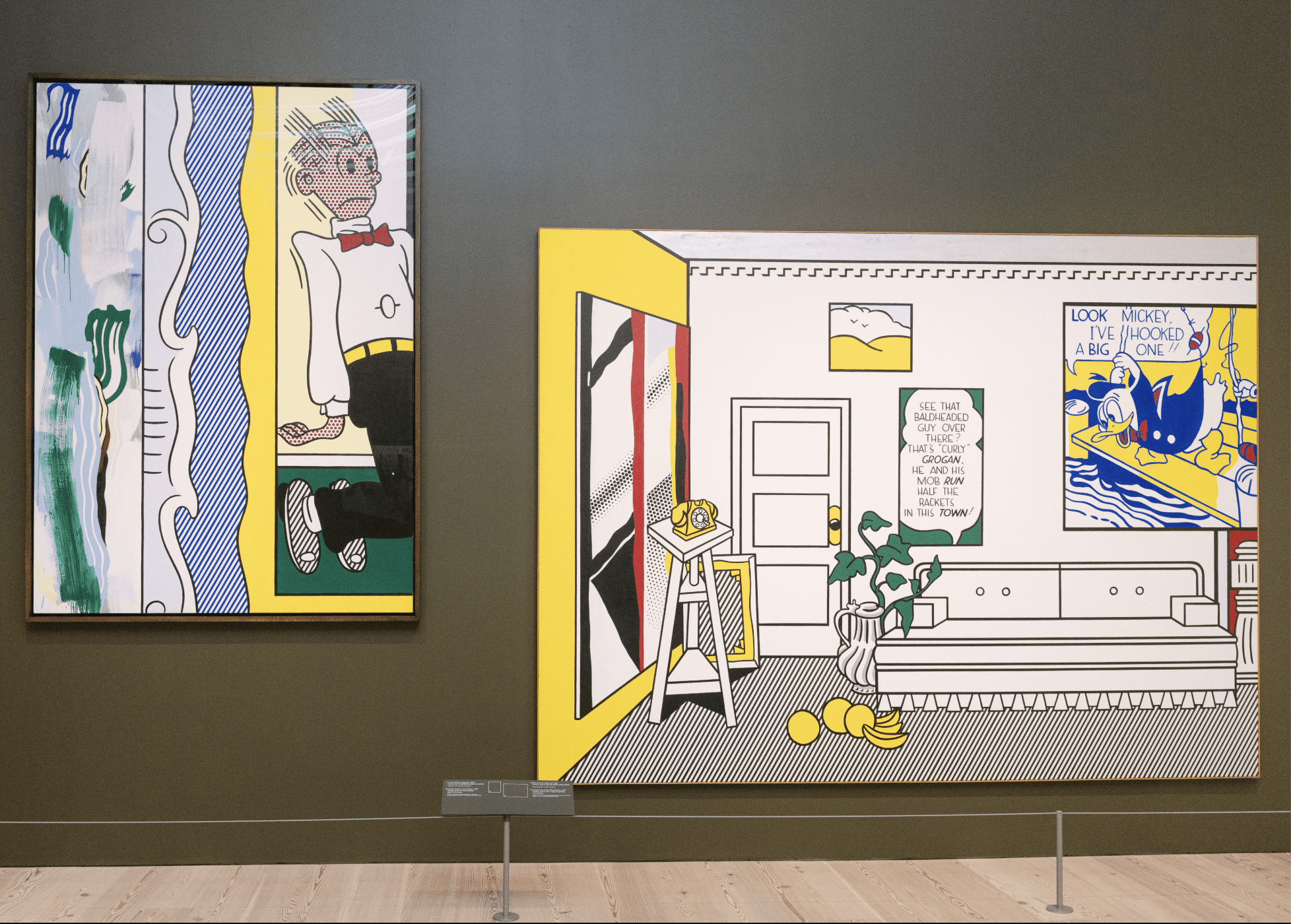
In Look Mickey, Donald Duck believes he has caught an enormous fish. His hook has actually caught his own clothing. Mickey covers his mouth as he laughs. The viewer understands what Donald does not.
Lichtenstein removed background figures, changed the viewpoint and reorganized the colors of the source illustration. Dots appear in Donald’s eyes and Mickey’s face. The joke survives, but the composition has become an experiment in how a printed image can occupy a canvas.
There is another joke inside that transformation. Donald sees what he wants to see. We congratulate ourselves on knowing better. Yet the painting also encourages us to mistake the look of reproduction for reproduction itself. Its humor catches both the character and the viewer.
A Masterpiece Before the Applause

Masterpiece (1962) turns artistic recognition into a romantic comic scene. A woman praises a man’s painting and predicts that New York will soon demand his work. In the exhibition’s audio guide, Only reads it as a kind of artistic manifesto.
For a painter who had worked for years outside the center of the New York art world, the prediction carries an appealing audacity. Success is already written into the picture, before the audience has decided what it thinks.
The work also leaves an uncomfortable question hanging over the scene. How much of a masterpiece’s authority comes from what is painted, and how much from the people announcing its importance? Lichtenstein makes the machinery of acclaim visible without pretending to stand outside it.
Drowning Girl: The Story He Removed

Roy Lichtenstein, Drowning Girl, 1963
Drowning Girl (1963) makes a different kind of interruption. A woman surrounded by waves refuses to ask Brad for help. There is no explanation, no preceding scene, no assured ending.
The source was a page illustrated by Tony Abruzzo for Secret Hearts, published by DC Comics in 1962. In the original, a boyfriend appears in the background, holding onto an overturned boat. Lichtenstein cropped the scene, shortened the text and changed the boyfriend’s name, leaving the woman isolated within the wave.
The loss of context becomes the painting’s emotional force. We are given the climax of a drama and denied the story that would resolve it. Her suffering is at once intensely visible and strangely inaccessible.
That contradiction allows two readings to coexist. The image exposes the conventions through which popular culture staged women’s distress. It also turns that distress into an exceptionally compelling object to look at. The painting does not dissolve the difficulty of its subject merely by making it beautiful.
Abruzzo’s authorship remains essential. Recognizing Lichtenstein’s transformation need not erase the person who first drew the image. Questions of invention, credit and unequal cultural value belong within the discussion of his achievement.
Happy Tears, and a Memory from South Korea

Roy Lichtenstein, Happy Tears, 1964
Happy Tears (1964), included in the Whitney exhibition, carries a particular history for audiences in South Korea. A red-haired woman smiles through tears. The title names her emotion, but the image withholds the circumstances that produced it.
For many Korean viewers, another narrative arrived first. In late 2007 and early 2008, the painting featured prominently in reporting on allegations involving Samsung, slush funds and purchases of expensive artworks. In early 2008, it was briefly shown to investigators and a small group of journalists at Seomi Gallery in Seoul. The gallery director and Samsung denied the allegations.
Those reports became part of the work’s public identity. One viewer encounters a Pop painting; another remembers news coverage of money and corporate power. The same face holds different histories.
At the Whitney, returning to Happy Tears means allowing the painting and that history to remain distinct, while acknowledging that memory changes how an image is seen. Its inclusion offers Korean audiences an opportunity to look beyond a familiar headline without forgetting how that familiarity was formed.
When a Brushstroke Becomes a Picture

Roy Lichtenstein, Brushstroke, 1965
In Little Big Painting (1965), sweeping strokes and apparent drips are bounded by crisp outlines. The expressive mark has become a carefully constructed image.

Roy Lichtenstein, Little Big Painting, 1965
The work engages the visual language of Abstract Expressionism, whose gestures could signify spontaneity and individual presence. Lichtenstein translates that language into flat forms and a dotted background. As art historian Michael Lobel observes in the Whitney’s discussion of the painting, it both parodies the earlier generation and succeeds as an abstract composition in its own right.
That dual achievement is crucial. The pleasure of the composition does not disappear when we understand the joke. Nor does the joke settle the larger question: how does an expression of individuality become a style that anyone can recognize and reproduce?
Beyond the Comic Panel

In Rouen Cathedral, Set III (1968–69), Lichtenstein translates Monet’s cathedral into five canvases, each organized through two colors. The viewer’s distance becomes part of the work: dots and intervals resolve into architecture, then separate again into marks.
Greene Street Mural (1983), recreated by hand at nearly ninety-six feet in length for this exhibition, brings his own imagery back into circulation. Borrowing extends into self-revision. A motif can return without occupying quite the same place in the artist’s thinking.
His later landscapes widen that inquiry further. Treetops Through the Fog (1996) belongs to a series responding to Chinese landscape painting. The National Gallery of Art connects this late project with Song dynasty motifs and with landscapes by Degas that Lichtenstein saw at the Metropolitan Museum of Art in 1994.
The change of atmosphere is striking. Dots that once described comic-book skin can evoke the recession of mountains and the uncertain edges of mist. A seemingly restrictive vocabulary proves capable of extraordinary spaciousness.
An Artist Still Changing

The Whitney’s accompanying exhibition Roy Lichtenstein: 1997, on the third floor, considers his final year. He was developing murals, sculptures and prints, expanding his palette and making images without his familiar heavy black outlines. His death from pneumonia complications that September left projects unfinished.
These works complicate the idea of an artist who found a successful formula and simply repeated it. His recognizable language was also a working system, available for revision until the end.
Like New brings that continuing restlessness into view. Its relevance lies partly in the ordinary acts through which images now travel: selecting, cropping, captioning, copying and sharing. Every act changes the relationship between a picture and the world around it.
The child’s book, the comic panel, the painting and the news photograph occupy different places in that journey. Looking again at Lichtenstein means asking what has been retained, what has disappeared, and whose work remains visible. Familiarity can bring us to the picture. Attention determines what we find there.
Exhibition Information

Roy Lichtenstein: Like New
Whitney Museum of American Art, New York, Floor 5
October 11, 2026–May 10, 2027
Member previews: October 8–10, 2026
Organized by Meg Onli and Alex Da Corte, with Nakai Falcón and David Crane.
Roy Lichtenstein: 1997
Whitney Museum of American Art, Floor 3
On view through June 1, 2027.
