The Art of Paying Attention: Houston’s Menil Collection
Brunch Magazine

The photographs of Houston’s Menil Collection begin with a modest encounter: a low roof, a shaded walkway, a lawn, and trees extending beyond the edge of a building. The museum enters the frame as part of a neighborhood. Its architecture gives the eye room to move between the work of human hands and the world outside.

This relationship between art and ordinary life is central to the Menil. Founded by John and Dominique de Menil, the institution welcomes visitors without an admission charge. Its museum buildings and green spaces form a 30-acre campus within a residential neighborhood in central Houston. Here, a visit can unfold across galleries, courtyards, sidewalks, and the shade of a live oak.
A Private Vision, Shared
John and Dominique de Menil moved from France to Houston during World War II. Their involvement in the city developed through art, education, and civil rights. After John’s death in 1973, Dominique continued the work that led to the museum’s inauguration in 1987.

The collection grew from personal curiosity, but the experience Dominique imagined was generous and public. She wanted visitors to retain the intimacy of an encounter with art, without becoming exhausted by the scale of a museum. That ambition remains legible in the building’s proportions: spaces that allow a work to hold attention, followed by places where the visitor can pause.

Today, the Menil’s holdings encompass more than 25,000 works, extending from the prehistoric era to the present. The breadth of that collection gives the museum a long view of human expression. A visit becomes an opportunity to consider how people across different times have given form to belief, imagination, and experience.

Renzo Piano: Building with Light

Renzo Piano at the "Festival della Scienza", Genoa, Italy.
The architect responsible for the Menil’s main building is Renzo Piano, born in Genoa, Italy, in 1937 into a family of builders. His background connects architecture to making: the behavior of materials, the logic of construction, and the possibilities of experiment. In 1971, he established Piano & Rogers with Richard Rogers; together, they won the competition for the Centre Pompidou in Paris. He founded Renzo Piano Building Workshop in 1981 and received the Pritzker Architecture Prize in 1998.


For New York audiences, his work is familiar through the Whitney Museum of American Art’s building in the Meatpacking District, which opened in 2015. The Whitney’s terraces extend the museum’s relationship with its urban surroundings. In Houston, the Menil offers another expression of that interest in the space between an institution and the city around it.

The main building opened in 1987. Its gray cypress siding and covered perimeter sit comfortably among nearby houses. Dominique’s brief called for a museum whose interior could feel expansive while its exterior remained modest. Piano gave that ambition architectural for

His most consequential material here is daylight. Working with engineers at Ove Arup & Partners, including Peter Rice and Tom Barker, Piano developed a roof system that brings natural light into the museum while addressing the preservation of artworks. Curved roof elements known as “leaves” distribute the light and temper harsh shadows.

Renzo Piano Building Workshop describes 291 ferrocement leaves forming the roof’s inner layer. Their repetition is both an engineering solution and a visual rhythm. In the supplied photographs, the white elements draw the eye along the building and overhead through its interior circulation space. Structure becomes a way of paying attention to light.

Cy Twombly: A Space for a Painter’s World
Piano returned to the campus for the Cy Twombly Gallery, which opened in 1995. Developed with Twombly and former Menil director Paul Winkler, the building drew on the artist’s sketches. Linen sailcloth filters sunlight beneath a glass roof, while unpainted plaster walls soften the atmosphere. [
The gallery presents five decades of Twombly’s paintings and sculptures. The artist selected the works and arranged their presentation, shaping a setting in which individual pieces could share an emotional atmosphere. His expressive marks bring painting close to writing, memory, and the passage of time.
One photograph supplied for this story shows an open publication titled Cy Twombly: Fifty Days at Iliam. The image offers an intimate editorial transition into the artist’s world: pages unfolding, lines gathering, red entering the field. It is a photograph of a publication, and its caption preserves that distinction.
A Continuing Conversation about Architecture
The campus also contains the Menil Drawing Institute, whose building opened in 2018. Designed by Johnston Marklee & Associates, it continues the Menil’s attention to daylight through a different architectural language. Its courtyards help modulate light for the display and protection of delicate works on paper.

The supplied photographs show wood, glass, white roof planes, and reflections of trees meeting at the entrance. These views belong to the Drawing Institute. Recognizing its separate authorship reveals how the campus has developed through several architects while sustaining a shared concern for the experience of looking.
Outside, Michael Heizer’s Rift, 1968/1982, introduces a sharp line into a gravel field. The work is one of the artist’s outdoor installations east of the Drawing Institute. Its form changes the ground from something passed over into something observed.
Art, Memory, and the Space Beyond the Museum
Nearby, Barnett Newman’s Broken Obelisk rises above the reflecting pool outside the Rothko Chapel. Dedicated to the Reverend Dr. Martin Luther King, Jr., the sculpture connects the de Menils’ commitment to art with their engagement in human rights.

This is a separate neighboring institution, with its own architectural history. The Chapel’s architects were Philip Johnson, Howard Barnstone, and Eugene Aubry. Its proximity enriches the wider experience of this part of Houston, bringing contemplation and civic memory into the same walk.
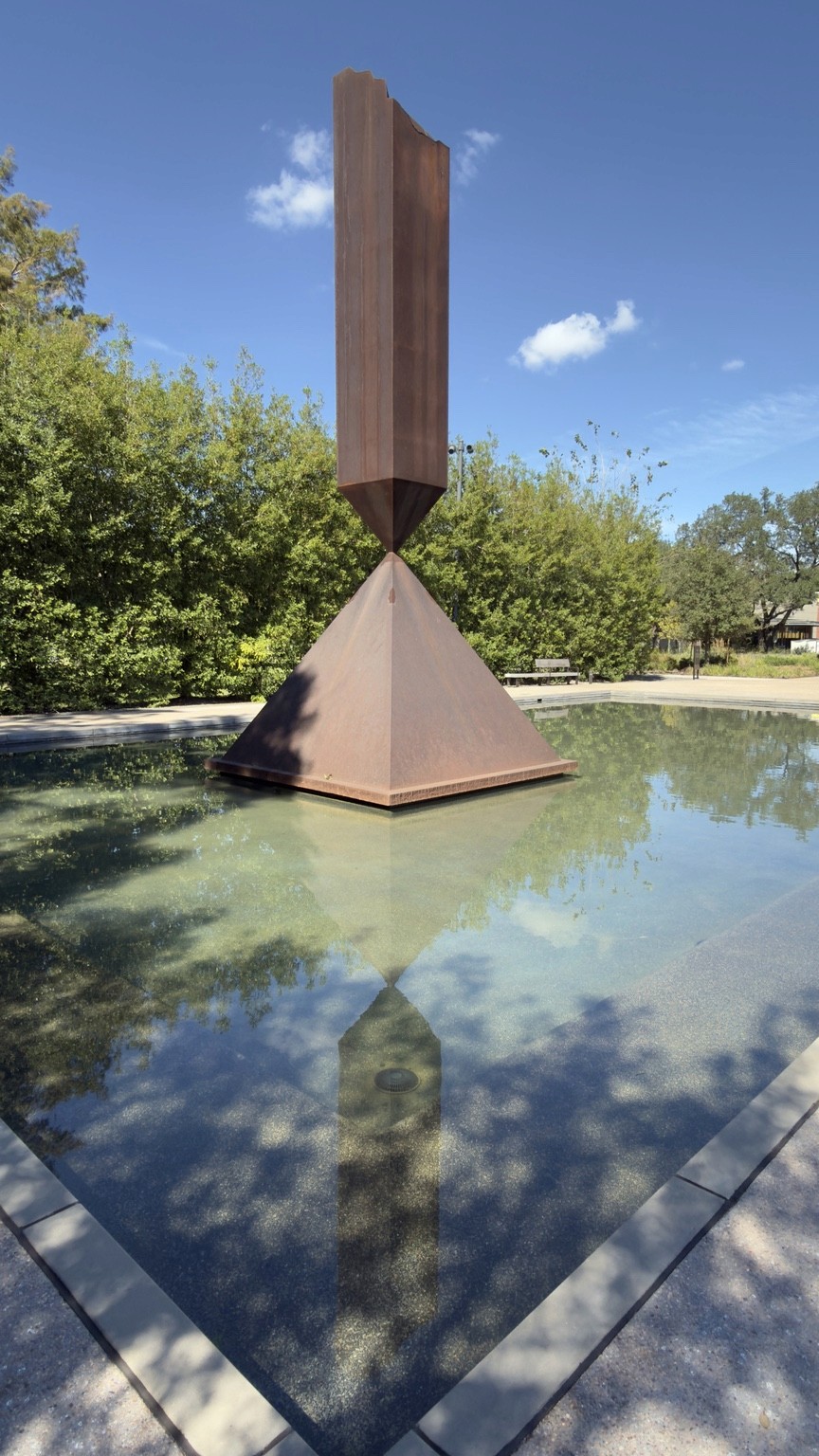
Across the photographs, the landscape keeps returning: branches, grass, shadows, benches, a sidewalk continuing past a museum wall. These images give the story its rhythm. The Menil’s significance resides in the artworks it holds and in the conditions it creates around them. It offers space to look carefully, and time to remain with what has been seen.