The Friendship Behind the Future of AI
Brunch Magazine
The Friendship Behind the Future of AI

NEW YORK — At a gala devoted to the relationship between the United States and Korea, SK Group Chairman Chey Tae-won raised a glass and offered a measure of ambition that his audience understood immediately: he hoped the partnership would grow faster than demand for GPUs. The line drew its humor from the vocabulary of an industry in extraordinary motion. Its meaning was more enduring. Technology moves through systems, factories and markets, but it is also built through relationships that people choose to sustain.
On September 28, The Korea Society presented its 2026 Van Fleet Award to Jensen Huang, founder and CEO of NVIDIA, at its Annual Gala at Cipriani South Street in New York. Samsung Electronics Executive Chairman Jay Y. Lee and Chey joined the celebration. Their presence placed three of the most influential figures in computing and memory in the same room. Their remarks gave a human dimension to the industrial partnerships that now connect them.
A gathering with a longer history

ⒸJensen Huang received the 2026 Van Fleet Award at The Korea Society’s Annual Gala in New York on September 28, 2026./Photos courtesy of The Korea Society.
The Korea Society was founded in 1957 by General James A. Van Fleet and others to strengthen understanding and cooperation between Americans and Koreans. Its work spans policy, business, education and culture. The Annual Gala brings those strands together, honoring people whose contributions give the bilateral relationship new depth. This year’s award recognized Huang’s leadership in AI and semiconductors and his sustained partnerships with Korean companies.
That institutional context matters. The relationship between Korea and the United States is often described through trade figures, investment plans and strategic agreements. The Korea Society creates another kind of space: one in which the people behind those commitments can meet, recognize shared work and carry a relationship beyond a single transaction. The gala was a celebration, but it was also an expression of the institution’s purpose.
For Lee, the occasion carried a family history. He told the audience that his late father had received the same award 20 years earlier. He then turned to a more personal history, recalling that he first met Huang at CES roughly 25 years ago. The two men have since watched computing change profoundly. In his congratulations, Lee spoke as an admirer of Huang’s work, a partner in a rapidly changing industry and, above all, a longtime friend.
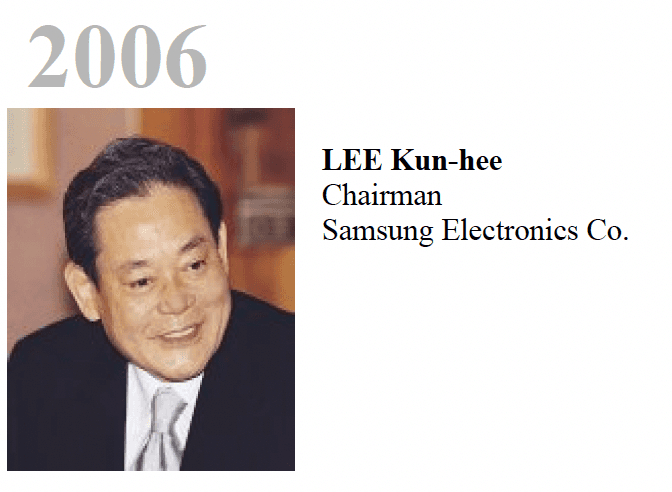
He also allowed the room to laugh. Huang, Lee said, had once told him that he hoped to die on the job. Lee’s answer was a gentle refusal: “You’re gonna live forever.” The joke worked because it came from familiarity. Within a formal ceremony, it revealed the ease of a friendship that has lasted through decades of change.

ⒸJay Y. Lee, Executive Chairman of Samsung Electronics, speaks at The Korea Society’s gala.
Chey’s toast carried a similar warmth. He thanked Huang for encouraging people to think bigger and said he was glad to be part of the partnership. Raising his glass to Huang, his family and the U.S.–Korea alliance, Chey looked toward the work still ahead. His playful comparison with GPU demand brought an immense technological shift back to a simple act: a public promise to keep building together.
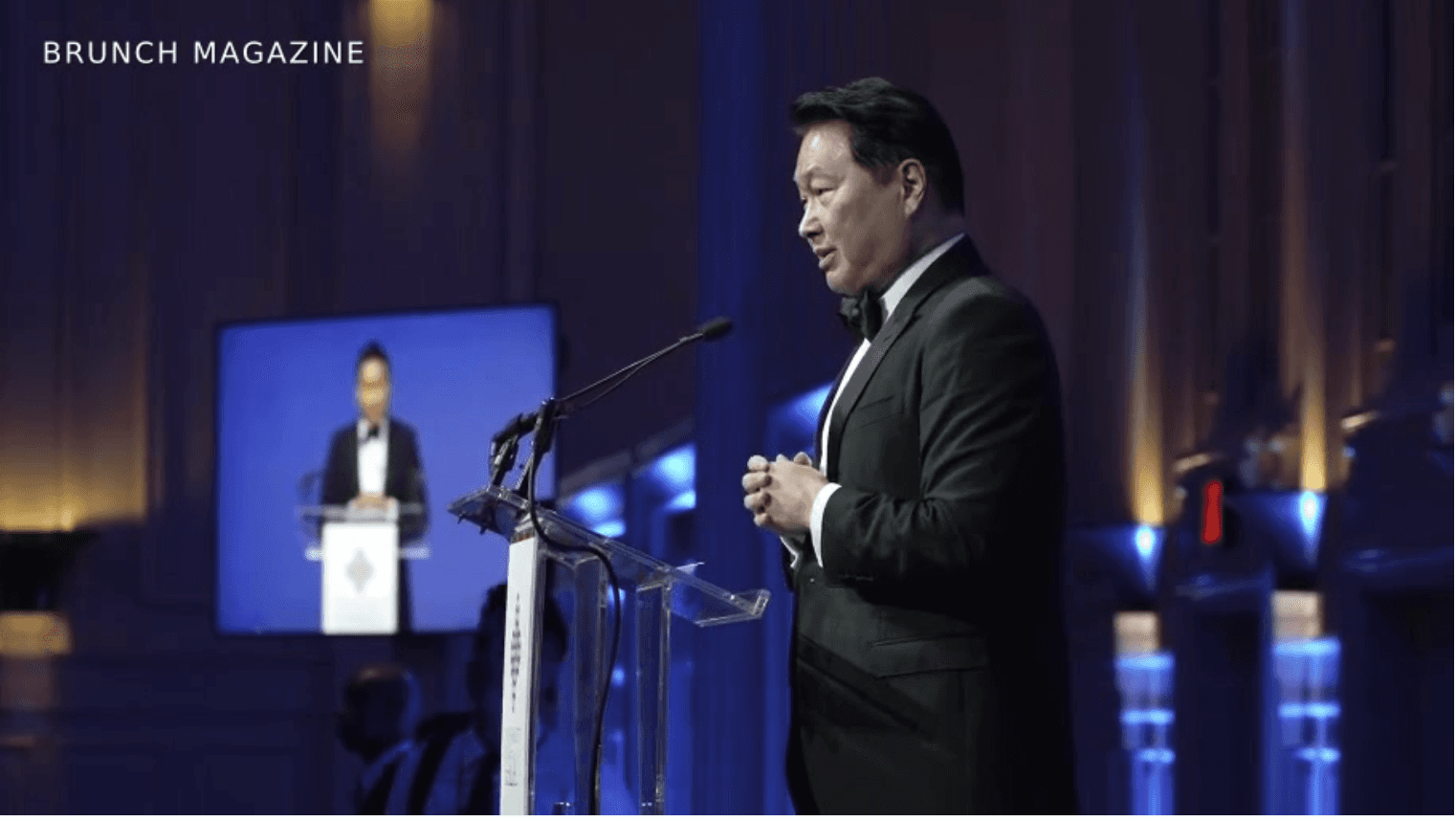
ⒸChey Tae-won, chairman of SK Group, offers a toast to Jensen Huang and the U.S.–Korea relationship at The Korea Society’s 2026 Annual Gala.
Korea’s place in the AI future
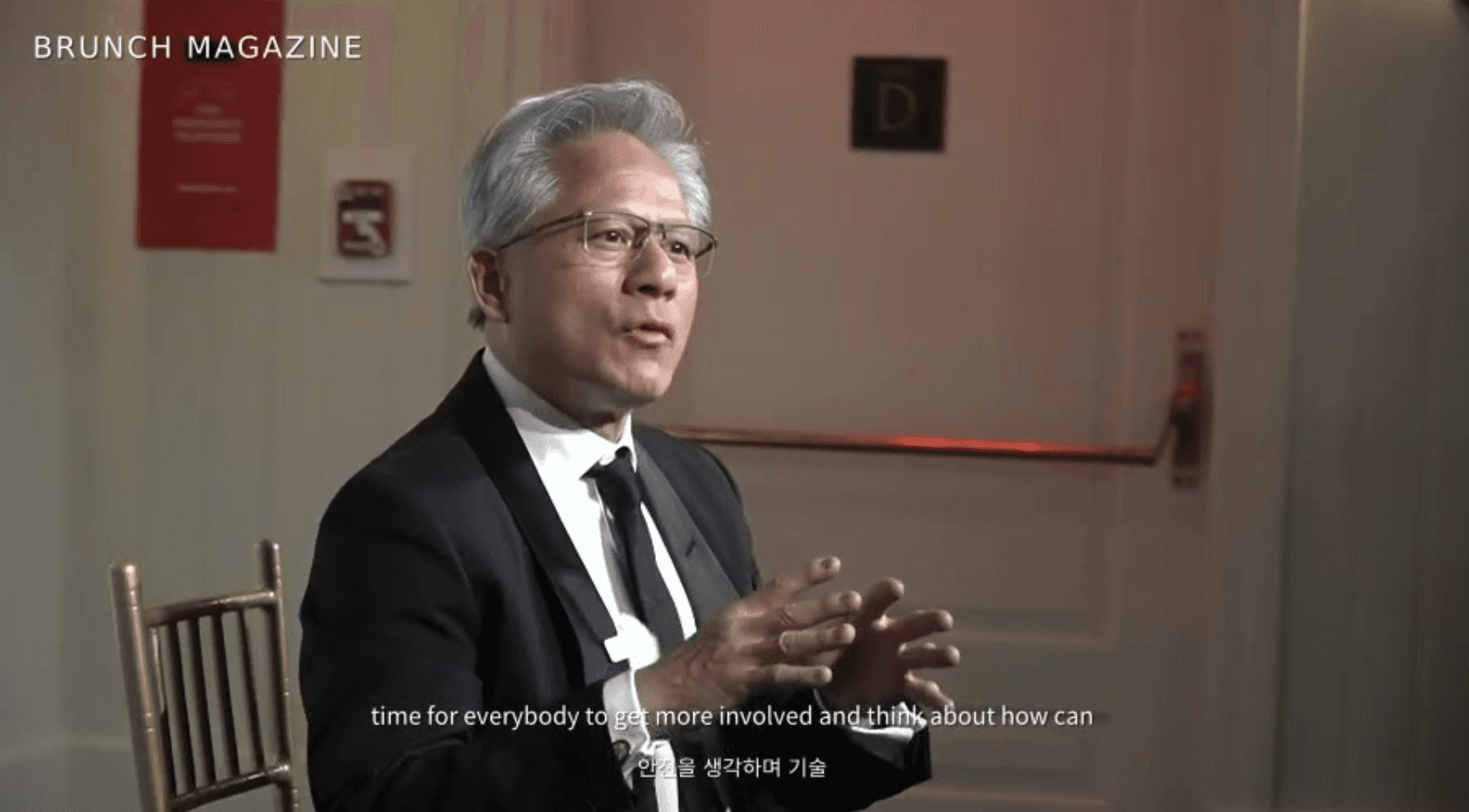
ⒸJensen_Huang_Press_Conversation_Korea_Society.
The relationships on display have practical foundations. AI systems depend on more than the processors associated with NVIDIA. They require advanced memory, manufacturing capacity, research, power and the ability to put new technology to work across industries. The Korea Society’s decision to honor Huang recognized both his contribution to that transformation and the Korean partners helping to make it possible.
In a conversation with reporters around the gala, Huang described Korea as a world leader in memory technology and manufacturing. He expressed confidence in working with Samsung and SK on components essential to AI infrastructure. He also described collaborations extending beyond semiconductors, including robotics, vehicles, research and the development of Korea’s own AI capabilities. His account presented Korea as both a creator and a user of the next generation of technology.
Huang returned repeatedly to the duration of those relationships. After working with Korea for 33 years, he said, he expected to work with Korean companies for another 33. His optimism captured something that short product cycles can obscure: consequential industrial partnerships are built through years of shared problem solving.
The conversation did no
t end with growth. Asked about standards and oversight, Huang argued that capability, safety and public trust should advance together. He spoke of common expectations for reliability, independent evaluation and a role for governments in establishing standards. Those questions belong alongside the evening’s optimism. If AI is to reshape industries and daily life, the measure of success will include how responsibly its builders act.
What the room represented

ⒸPhotos courtesy of The Korea Society.
The gala gathered leaders of some of the world’s most influential technology companies. Its deeper story emerged in their words. A Korean industrial leader offered a toast to a technology founder. Another recalled a family connection to the award and a friendship formed a quarter-century earlier. The honoree, in turn, described how deeply his work is connected to Korea’s people, companies and technical strengths. The Korea Society gave those stories a common setting and a historical frame.
The Van Fleet Award looks back to a commitment to friendship between two countries. In 2026, that commitment also points forward. Memory chips, AI systems and factories will change; the specific technologies of this moment will give way to others. The ability to meet across borders, to trust one another’s expertise and to take responsibility for what is built together will remain essential.
For one evening in New York, the future of technology had faces and voices. The Korea Society’s achievement was to remind the room that progress depends on invention and on the relationships that allow it to become shared work.