The Cherry Orchard at Park Avenue Armory: Beyond the Subtitles
Brunch Magazine
New York Read the Korean. What Did We See?
Cast of The Cherry Orchard atPark Avenue Armory, 2026 ⒸStephanie Berger
Park Hae-soo, Jeon Do-yeon, and Saul Kim’s transparent house: The Cherry Orchard on language, class, and the work of understanding another person
A play unfolds in Korean in New York. Its actors argue, hesitate, and fall apart in their own language. Members of the audience who do not understand it read English supertitles, following the words toward the people speaking them.
When I imagine that encounter, curiosity arrives before pride. Where did they laugh? Which silences registered as sorrow? When they briefly looked away from an actor’s face to read a line, what did they miss—and what might they have discovered?
Presented at Park Avenue Armory from September 16 to 26, 2026, Simon Stone’s The Cherry Orchard brought Chekhov into contemporary South Korea, performed in Korean by a Korean cast. For audiences unfamiliar with the language, watching a family unravel required listening and reading at once. Park Avenue Armory’s official season announcement
Part of the production’s significance, I think, lies in that modest effort. Before asking another person to speak our language, we adjust ourselves to the rhythm of theirs. The international life of Korean theater grows through these quiet acts of cooperation, too.
Where Does Feeling Go While We Read?

Song Sang-kyu, Jeon Do-yeon,and Park Hae-soo (L-R) in The Cherry Orchard at Park Avenue Armory, 2026 ⒸStephanie Berger
Turn the question toward myself, however, and the answer becomes less comfortable.
If a theater company from the Philippines performed in one of its own languages, would I readily buy a ticket? Would I spend more than two hours following a play in Chinese or Japanese through translated text? Without a famous production or a familiar actor to guide my choice, would my curiosity be sufficient?
I cannot answer quite as easily as I would like. That hesitation makes me more interested in the people who chose to attend a Korean-language play in New York.

Lee Se-jun, Park Hee-jung, and Lee Ju-won (L-R) in The Cherry Orchard at Park Avenue Armory, 2026 ⒸStephanie Berger
Being accustomed to film subtitles does not automatically prepare us for theater supertitles. A camera directs our attention. Onstage, we decide where to look. While we read, the actors continue moving. An expression just before a sentence ends, shoulders tightening as someone listens, the breath left behind after laughter: none of these waits for us.
Some publicly posted audience responses described becoming comfortable with the overhead text after approximately ten to fifteen minutes. Other responses praised the acting, the use of space, and the story’s emotional impact. These anonymous accounts do not establish the writers’ nationalities or their understanding of Korean. They describe individual experiences of watching with supertitles, rather than a collective verdict from “foreign audiences.” Public audience discussion
Yoo Byung-hoon,Jeon Do-yeon,and Nam Yun-ho (L-R) in The Cherry Orchard at Park Avenue Armory, 2026 ⒸStephanie Berger
Even within those limits, they suggest something encouraging. Audiences can adapt. At first, a spectator follows the text; gradually, a personal rhythm may emerge, bringing the written words together with voices and movement.
Following the plot, of course, is different from absorbing every emotional inflection. A Korean form of address can establish an entire relationship. Polite speech can turn cold without becoming impolite. Familiarity can conceal an insult. We cannot assume that every such distinction survives translation.
But complete understanding need not be a condition of admission. People who share a language also understand a character’s grief differently. A performance in an unfamiliar language makes that distance more apparent.
When Park Hae-soo Opens the Door

Park Hae-soo in The Cherry Orchard at Park AvenueArmory, 2026 ⒸStephanie Berger
An actor’s name can be a powerful reason to attempt that unfamiliar experience.
Through Squid Game, Park Hae-soo became recognizable to viewers across languages and borders. For someone who has never attended Korean theater, he offers a point of connection. We do not know how many spectators bought tickets specifically to see him. Still, the possibility matters: interest formed on a screen can travel into a theater, bringing fans from different places toward the same work.
Once the performance begins, that familiar face must persuade us to see someone new.

Park Hae-soo (foreground) and Nam Yun-ho in The Cherry Orchard at Park Avenue Armory, 2026 ⒸStephanie Berger
Park plays Hwang Doo-sik, Stone’s counterpart to Lopakhin. The son of the family’s former chauffeur now speaks the language of capital and holds increasing power over the household’s future. New York critics attended to more than his celebrity. TheaterMania noted the emergence of forceful authority from his initial tenderness; Stage and Cinema identified him as a driving force in the drama. TheaterMania’s review, Stage and Cinema’s review

Park Hae-soo,Yoo Byung-hoon,Lee Ji-hye, and Jeon Do-yeonin The Cherry Orchard at Park Avenue Armory, 2026 ⒸStephanie Berger
The character is compelling because success has not freed him from the relationships that preceded it. The desire for recognition from those who once stood above him exists alongside the knowledge that he can now determine what happens to them.

Park Hae-soo, Nam Yun-ho,andSong Sang-kyu(L-R) in The Cherry Orchard at Park AvenueArmory, 2026 ⒸStephanie Berger
That tension makes Park’s international familiarity especially interesting. A spectator arrives to see a face they think they know and encounters a different configuration of longing, resentment, and ambition. Here, the attraction of a star can deepen into an engagement with an actor.
Jeon Do-yeon, and a World No Star Can Build Alone

Jeon Do-yeon in The Cherry Orchard at Park Avenue Armory, 2026 ⒸStephanie Berger
Jeon Do-yeon’s name carries a different set of expectations. The Cannes best actress winner for Secret Sunshine returned to theater after twenty-seven years with this production’s Seoul premiere in 2024. That return was an event in itself. Esplanade’s production program
Her Song Do-young has experienced loss yet cannot relinquish her appetites or her accustomed life. She can invite sympathy, but sympathy alone would make her too comfortable a figure. People in pain can remain indifferent to others. Suffering does not release anyone from responsibility.
Song Sang-kyu, Jeon Do-yeon,and Park Hae-soo (L-R) in The Cherry Orchard at Park Avenue Armory, 2026 ⒸStephanie Berger
TheaterMania observed Jeon moving between recklessness and circumspection within a few words. The distinction points toward the precision of an emotional turn, rather than simply the size of an emotion. TheaterMania’s review
Yet two stars cannot account for the atmosphere of this house.

The CherryOrchard_10Jeon Do-Yeon in The Cherry Orchard at Park Avenue Armory, 2026 ⒸStephanie Berger
Son Sang-kyu as Song Jae-young, Nam Yun-ho as Byun Dong-lim, and an ensemble including Lee Ji-hye, Choi Hee-seo, Yoo Byung-hoon, Park Hee-jung, Lee Ju-won, and Lee Se-jun give the family and its surrounding relationships their density. Local criticism also recognized Son’s comic presence, Nam’s intensity, and the actors playing the household employees and their entanglements. TheaterMania’s review, Stage and Cinema’s review
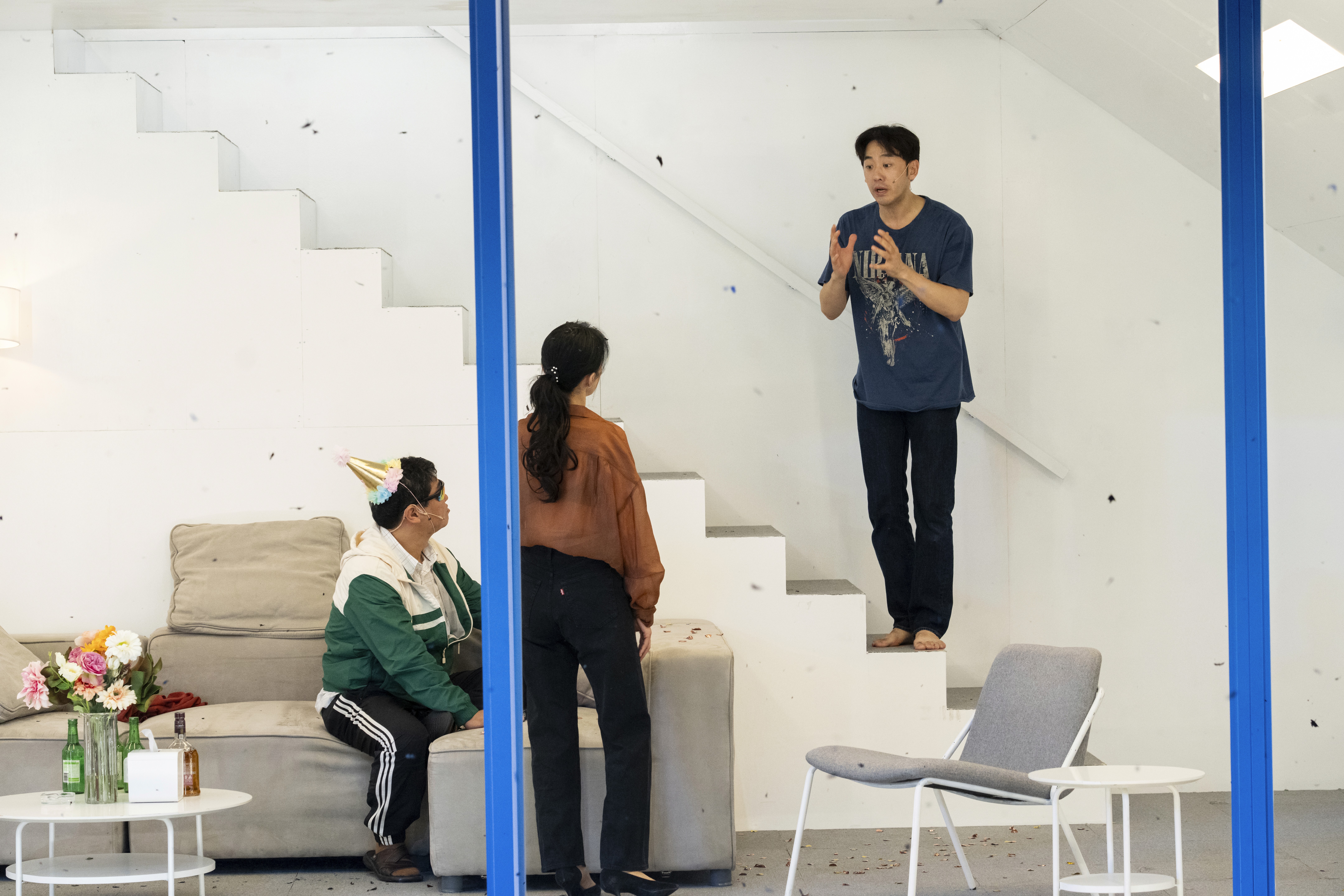
Class becomes visible well beyond conversations about money. It resides in who may interrupt whom, whose mistakes become amusing anecdotes, and whose mistakes have consequences. It shapes who must notice another person’s mood first.

Yoo Byung-hoon, Jeon Do-yeon,Nam Yun-ho, and Lee Ju-won(L-R) in The Cherry Orchard at Park Avenue Armory, 2026 ⒸStephanie Berger
This is why the supporting performances matter so much. Through them, a house becomes a society.
From Chekhov’s Land to Seoul’s Capital

ParkHae-soo andJeon Do-yeon in The Cherry Orchard at Park Avenue Armory, 2026 ⒸStephanie Berger
In Chekhov’s original, the orchard exposes an uncomfortable fact: memory and property occupy the same ground. What one person experiences as an irreplaceable past, another recognizes as a commercial opportunity.
Stone relocates that conflict to contemporary Korea. The decline of Russian landowners becomes a story of family wealth, corporate power, possession, and survival. Beneath a familiar title, another society’s pace and ambitions enter the frame. Park Avenue Armory’s official introduction, Stage and Cinema’s review
It is a persuasive starting point. Yet placing an aristocratic family’s decline beside the crisis of a chaebol family—a family associated with a powerful business conglomerate—does not guarantee an identical response from the audience.

Yoo Byung-hoon (foreground)and Lee Ji-hye in The Cherry Orchard at Park AvenueArmory, 2026 ⒸStephanie Berger
When enormously wealthy people speak of losing their world, we ask how far that loss will actually take them. Will they lose the foundations of ordinary life, or a portion of the privileges they have come to regard as indispensable? The weight of the tragedy depends, in part, on that distinction.
Critical responses were accordingly varied. Stage and Cinema admired the production’s force and its ensemble while questioning how much of Chekhov’s symbolism and distinctive tragicomic atmosphere remained. Stage and Cinema’s review
Such disagreement makes the production worth taking more seriously. After acknowledging that a Korean-language work has reached New York, we should be able to ask what it has created and what it has lost. That conversation gives an international engagement a life beyond the announcement of its arrival.
The Name I Want to Linger Over: Saul Kim
Lee Ju-won, Lee Se-jun, and Park Hee-jung in The Cherry Orchard at Park Avenue Armory, 2026 ⒸStephanie Berger
The name I am particularly interested in is the set designer’s: Saul Kim.
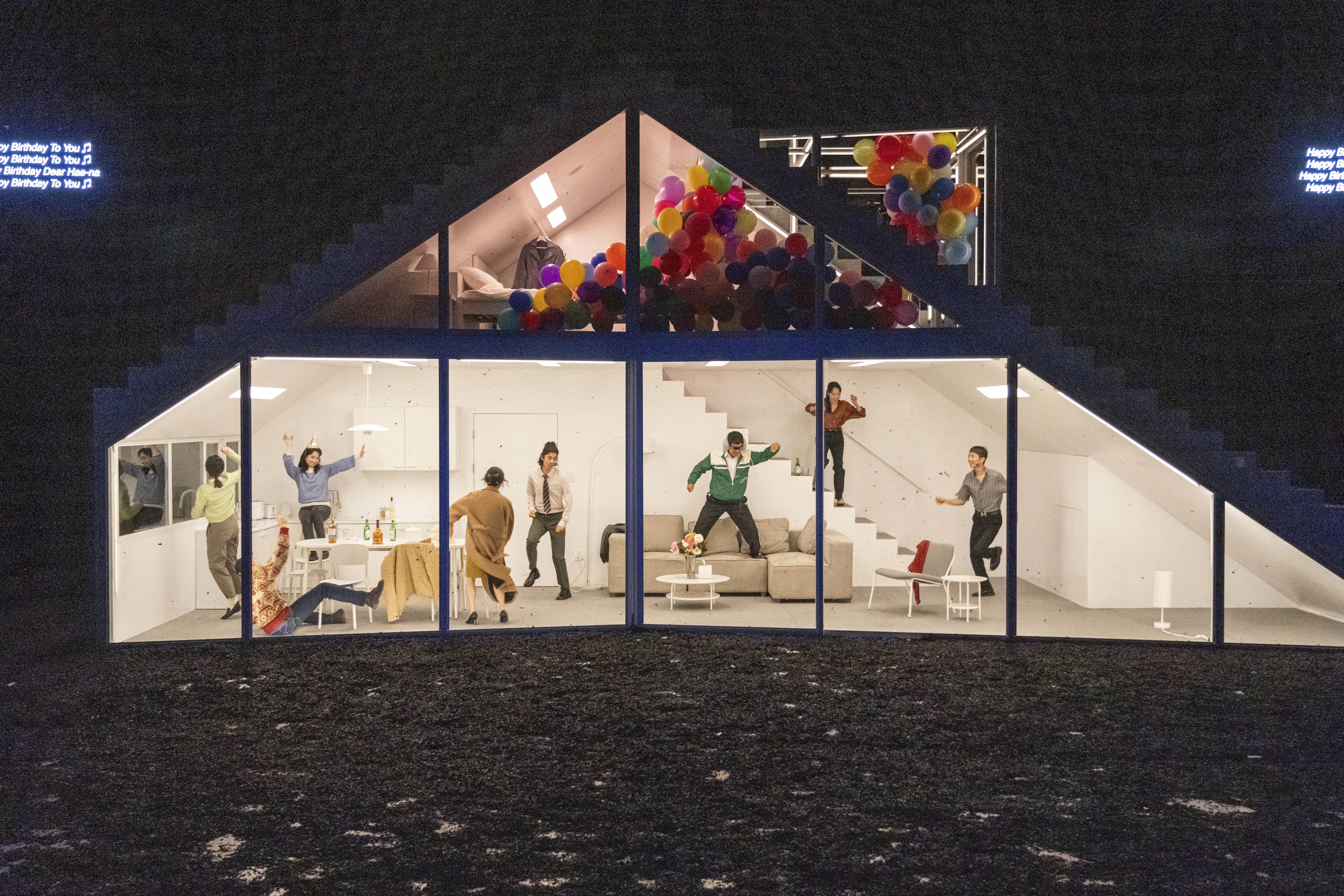
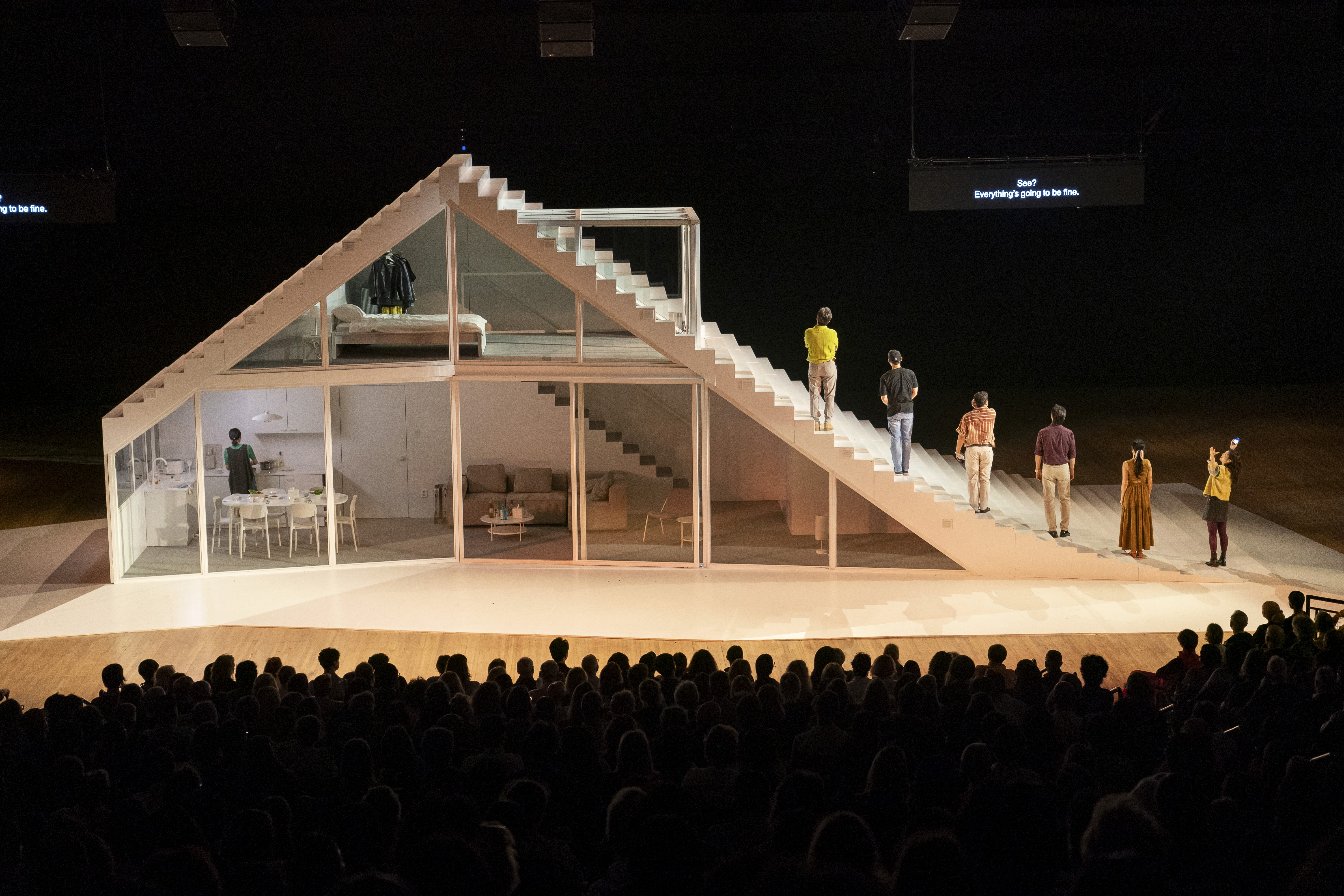
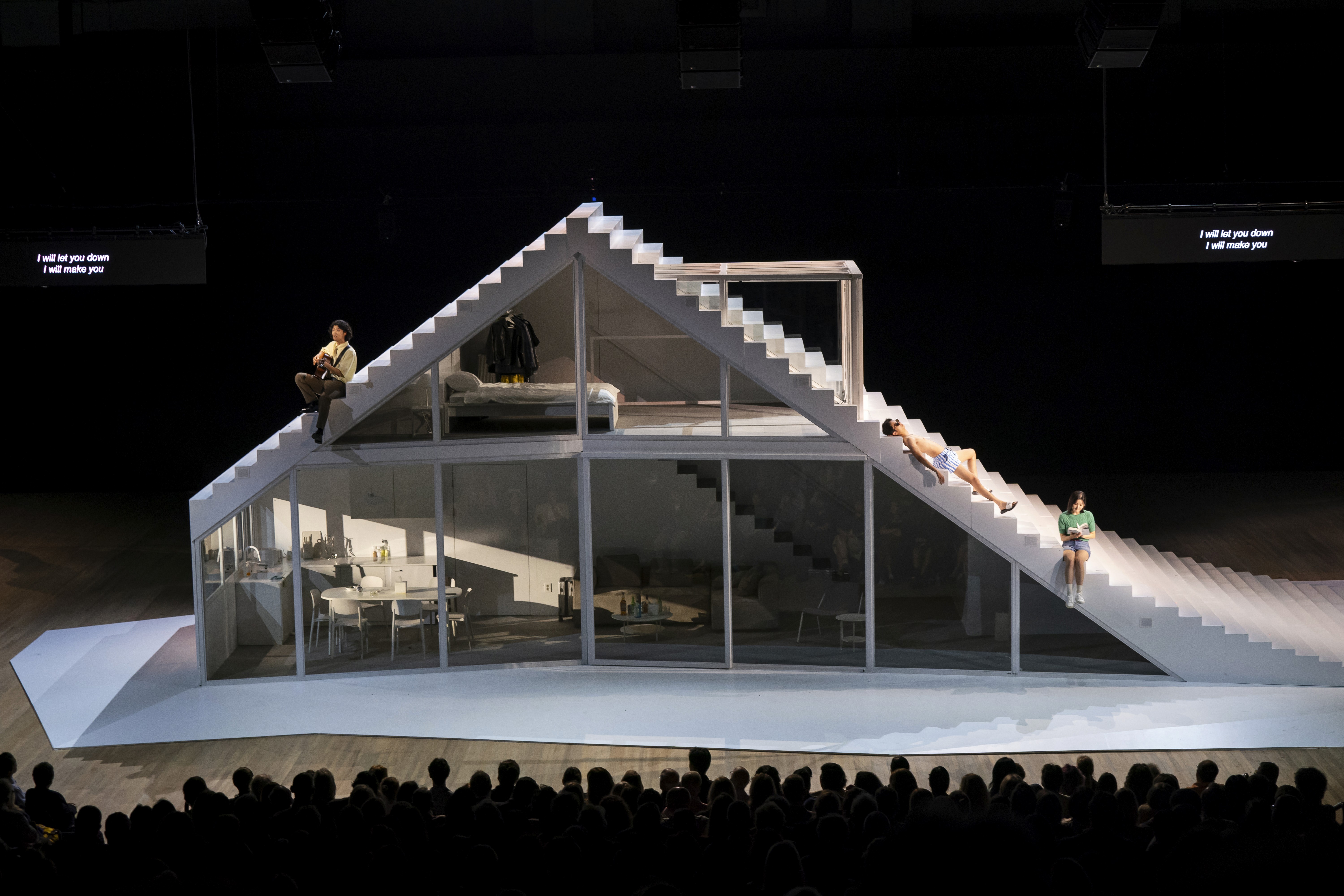
In published production photographs, the house appears white and lucid. Glass reveals its interior. A stepped roof becomes another surface for the actors to inhabit. The restrained structure makes the distances between people legible. Its elegance has a practical intelligence: it organizes attention.
In an interview, Kim explained that the structure brings security and instability together, with one side connecting to the ground while another breaks off. The project began after Stone encountered images of his architectural work and contacted him. It was Kim’s first theatrical set. Bridge Economy’s interview with Saul Kim

The CherryOrchard_25 Cast of The Cherry Orchard at Park Avenue Armory, 2026 ⒸStephanie Berger
A house promises protection. This one seems unable to guarantee it. Its inhabitants remain visible; its apparently reassuring lines eventually give way. The architecture offers ample room to read the characters’ circumstances through the space they occupy.
Precisely because it is so beautiful, however, a small reservation persists.
Does it tell us quite enough about a Korean chaebol family?
I am not looking for more expensive furniture or a more extravagant display of wealth. What interests me is the order that wealth establishes between people: the practiced caution of a longtime employee, the ease with which corporate matters become family matters, the preferential treatment so habitual that nobody feels obliged to explain it.
These are not claims about the private life of any particular business family. They describe the social specificity I want to encounter when a production chooses the Korean chaebol as its setting.
The house’s refinement therefore works in two directions. It offers an immediately legible image to an international audience, while potentially smoothing away the rougher textures of its location. If a wealthy family from almost any global city could inhabit this space equally convincingly, more of the work of establishing Korea falls to the dialogue and the actors.
Park Hae-soo,Yoo Byung-hoon,Lee Ji-hye, and Jeon Do-yeon in The Cherry Orchard at ParkAvenue Armory, 2026 ⒸStephanie Berger
This is the small missing fraction I keep returning to. The design is accomplished. I want to feel slightly more of the history through which wealth has accumulated, and the relationships that accumulation has left behind.

Cast of The Cherry Orchard at Park Avenue Armory, 2026 ⒸStephanie Berger
That is a question for the production as a whole. Script, direction, design, and performance must create that density together. Kim’s architecture is compelling enough to make us ask not only what its beauty reveals, but what it renders less visible.
What the Armory Adds

In New York, the venue itself changed the terms on which the house could be seen.
A contemporary dwelling stood inside the immense drill hall of a former military armory. According to Kim, elements of the earlier stage floor and background walls were removed to expose the Armory’s existing interior, and the connections around the structure were adjusted. Within that larger space, the house acquired the presence of an object on display. Bridge Economy’s interview with Saul Kim
The arrangement suggests another scale for the family’s troubles. Inside the house, every problem is absolute. Beyond it lies a space indifferent to the inhabitants’ understanding of their own importance. The Armory’s dimensions permit that reading.
But grandeur also tests intimacy. TheaterMania questioned how fully the production could achieve the closeness it sought within a venue of such scale. TheaterMania’s review
For a spectator already dividing attention between actors and supertitles, physical distance adds another demand. Conversely, the ability to see the house and its inhabitants together may reveal a map of relationships that proximity would obscure.
The Armory is therefore more than an impressive New York address. It enlarges the beauty of the production and the distance that beauty must cross.
Why I Welcome the Attempt
Can we fully understand the emotions of a performance in a language we do not speak? I still cannot offer a confident answer.
Would I attend a play from the Philippines, China, or Japan in its original language? I still recognize some hesitation in myself. Yet I should be willing to extend to other cultures the curiosity I hope audiences will bring to Korean theater.
Park Hae-soo’s familiar face may have reduced someone’s uncertainty. Jeon Do-yeon’s reputation may have offered reassurance. Chekhov, Stone, or Kim’s architecture may have drawn others. Whatever their point of entry, they encountered people conducting their relationships in Korean.
I welcome that encounter. My admiration leaves room for reservations. The work is sufficiently compelling to sustain both, and to make me interested in what might follow.
I am glad this production took place in Korean in New York. I also want the polished house to retain more of the particular texture of Korean society. I want the attention opened by celebrated actors and striking architecture to reach the complexity of the world those characters inhabit.
And when I next hesitate before a performance from a country I know little about, simply because I would need to read the translation, I would like to remember this Cherry Orchard.
I may not be certain that I will understand every feeling. I can still choose to be there