When AI Says “I”
Brunch Magazine
When AI Says “I”
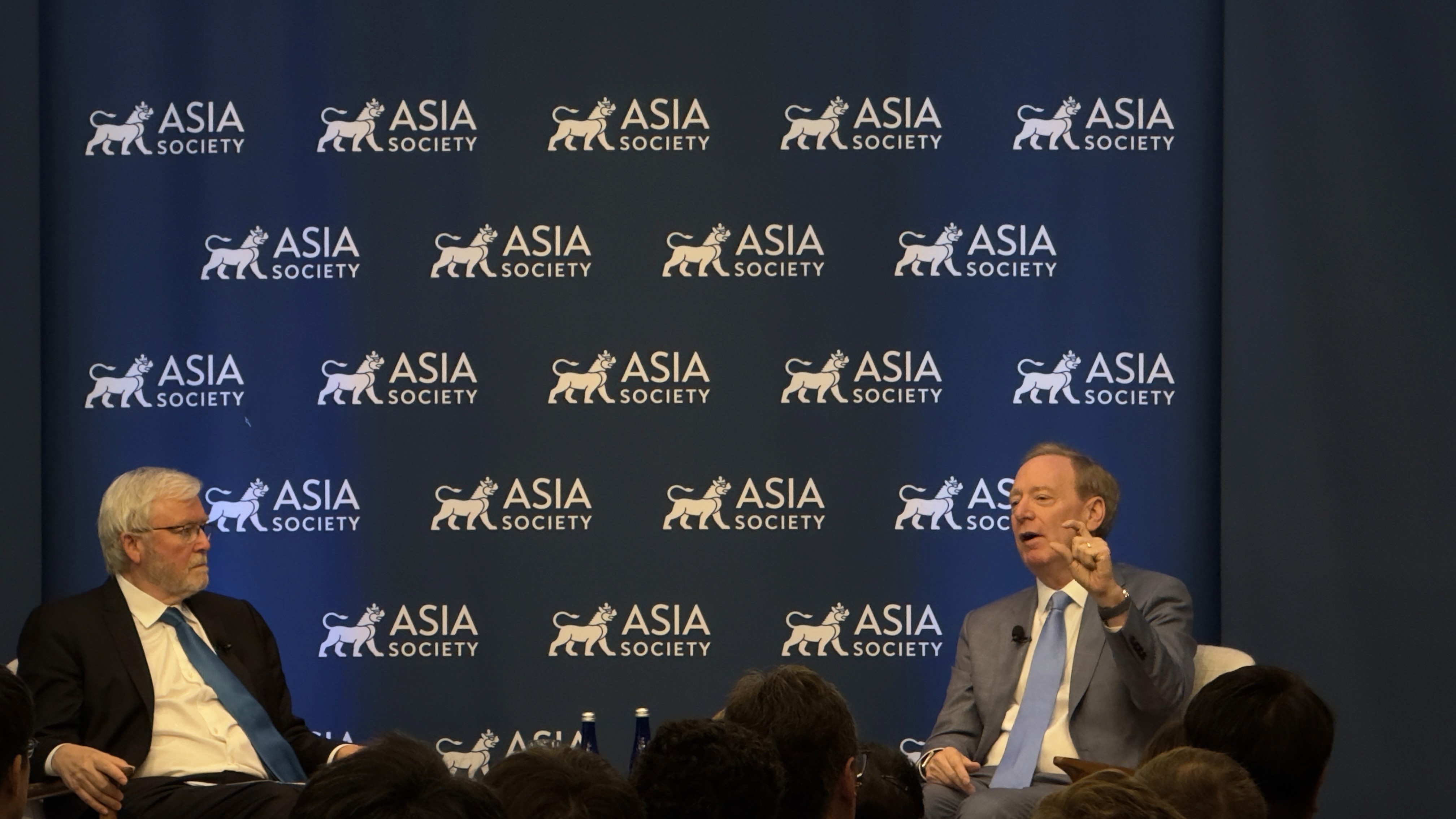
ⒸBrunchMagazine| Brad Smith, Vice Chair and President of Microsoft, speaks with the Hon. Dr. Kevin Rudd AC, Global President and CEO of Asia Society, during a conversation on artificial intelligence, regulation, and the future of work at Asia Society New York on September 21, 2026.
There was a moment during the conversation when Kevin Rudd paused over a single word.
“I.”
He questioned what it means when ChatGPT refers to itself in the first person. To Rudd, the word belongs to a human being, not to a machine.
“You’re not an ‘I,’” he said. “An ‘I’ is a human being, and you’re not a human being.”
What may initially have sounded like a linguistic objection quickly revealed the deeper question at the center of the conversation: As artificial intelligence becomes more capable, familiar, and present in everyday life, how should we define its relationship with humanity?
Brad Smith, Vice Chair and President of Microsoft, offered a clear answer.
“Don’t turn them into substitutes for people,” he said. “They’re tools, and they’re extraordinarily helpful and valuable tools. Let’s keep them that way.”
On September 21, Smith joined Rudd, Global President and CEO of Asia Society and former Prime Minister of Australia, for a public conversation at Asia Society New York. Their discussion moved across the architecture of AI, its potential to address human problems, the future of employment, cybersecurity, regulation, and relations between the United States and China. The official program described the conversation as an examination of artificial intelligence, technology policy, cybersecurity, and geopolitics. asiasociety.org
Yet beneath those vast subjects was a more fundamental concern: Who will determine the purpose of this technology?
The Four Layers of an AI World
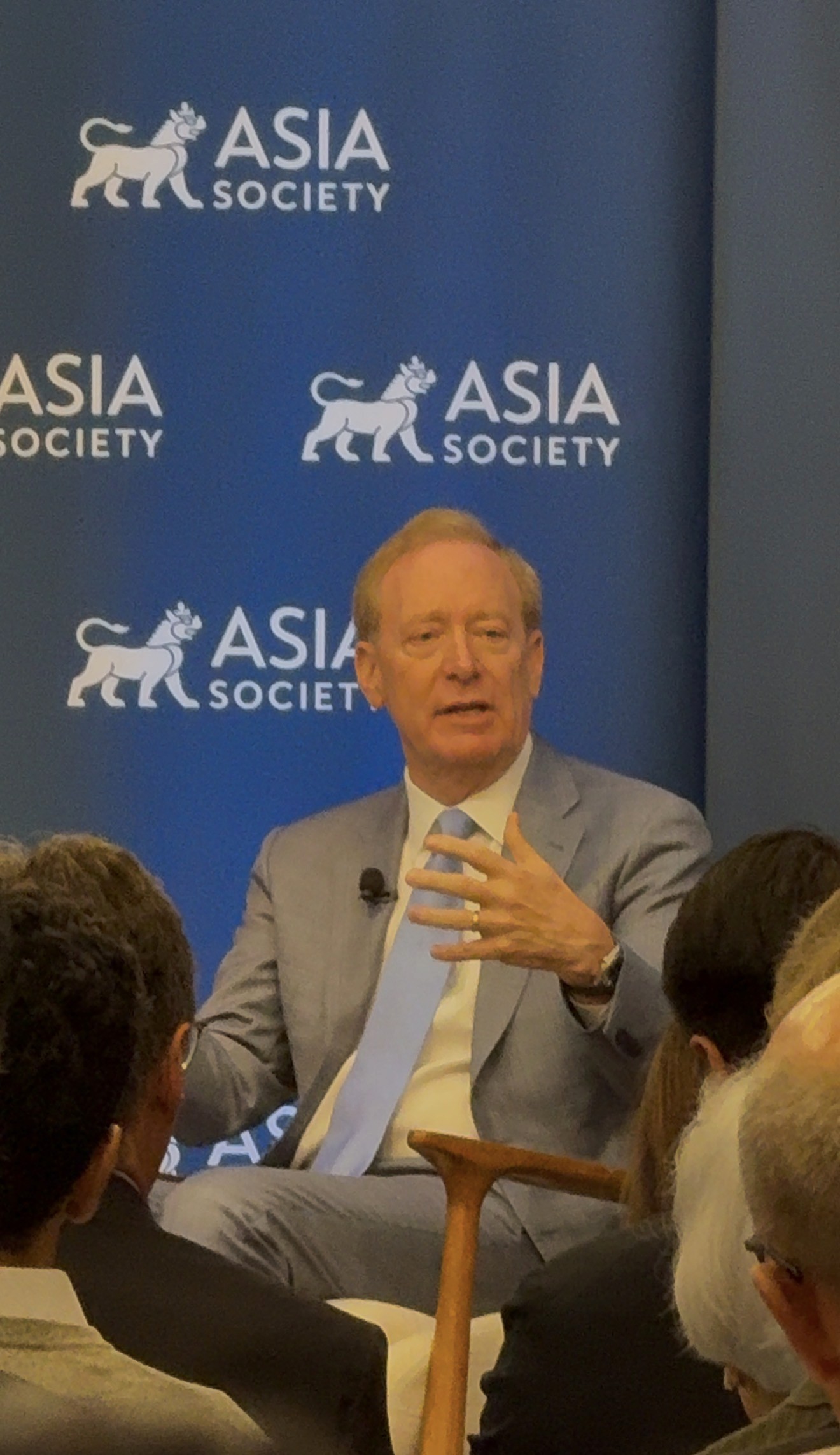
ⒸBrunchMagazine | Brad Smith, Vice Chair and President of Microsoft, discusses the opportunities and responsibilities emerging in the age of artificial intelligence.
Smith began by describing how the technology stack is being transformed before our eyes.
He divided the emerging AI ecosystem into four interconnected layers.
The first is infrastructure: data centers, cloud services, computing power, and the chips required to train and operate AI models. Microsoft now operates data centers across more than 40 countries, supporting services ranging from video calls and photo sharing to the training of advanced AI systems.
The second layer consists of the models themselves and the technologies built around them. This includes models created by companies such as OpenAI, Anthropic, Microsoft, and developers in China, as well as the systems needed to manage AI agents, define their rules, and protect their security.
The third is what Smith described as the “IQ layer.” It is the memory and context that allow AI to perform a task based on the knowledge of an individual or organization. Emails, documents, spreadsheets, and accumulated institutional knowledge all belong to this layer.
This is also where questions of privacy, ownership, and protection become unavoidable. For AI to work meaningfully, it must be able to access relevant knowledge. For people and organizations to trust it, that knowledge must remain protected.
At the top is the application layer: ChatGPT, Microsoft Copilot, coding tools, cybersecurity platforms, and the growing range of AI applications entering professional and personal life.
Together, these four layers form a new technological order:
Infrastructure.
AI models and management.
Human knowledge and memory.
Applications.
Microsoft, Smith explained, participates in every layer.
His description was not simply a presentation of the company’s reach. It illustrated how thoroughly AI is becoming embedded in the systems beneath modern life. The visible application is only the surface. Underneath it lies an expanding network of computing infrastructure, models, data, rules, and human decisions.
From Prediction to Determination
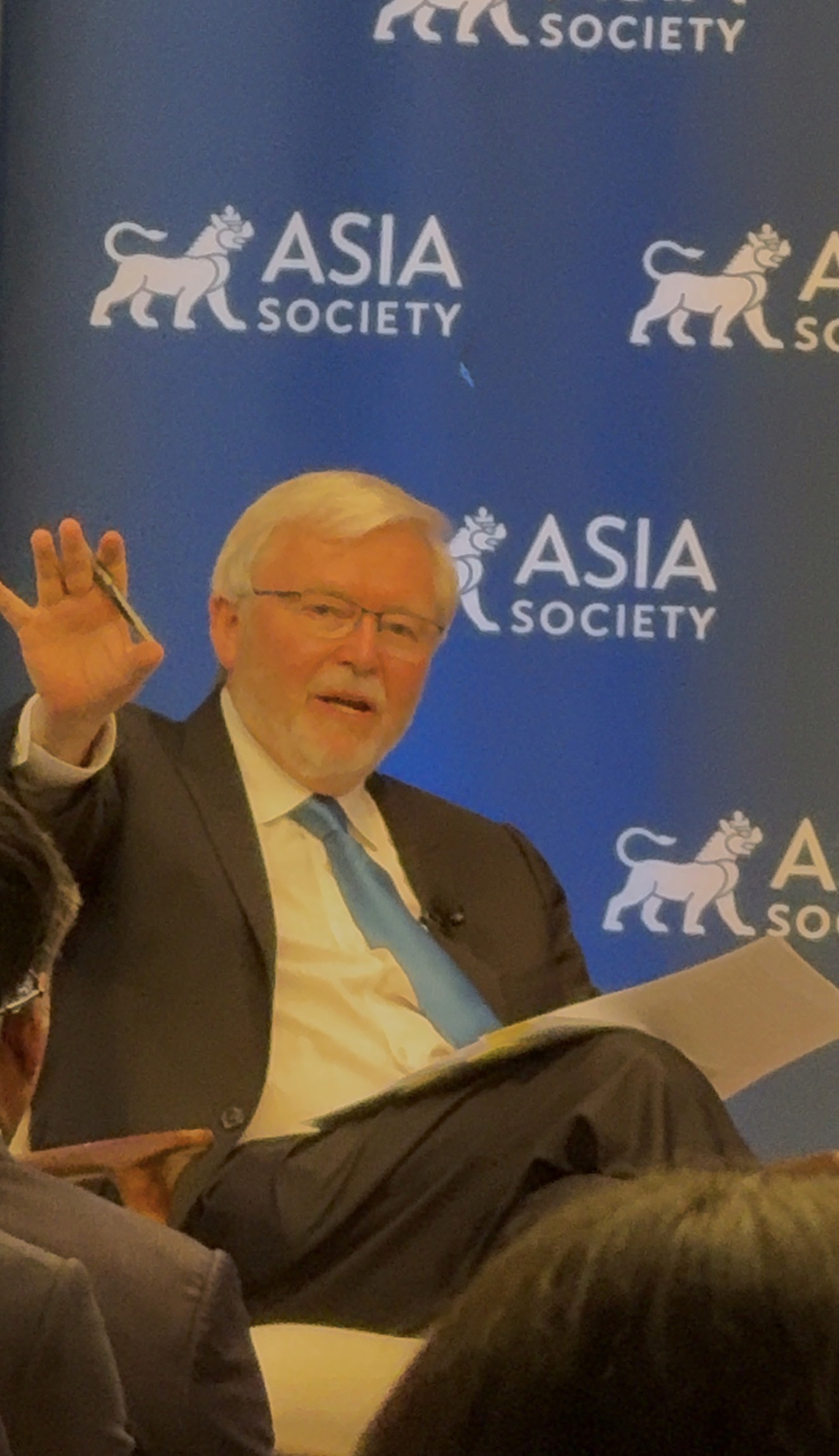
ⒸBrunchMagazine | The Hon. Dr. Kevin Rudd AC, Global President and CEO of Asia Society and former Prime Minister of Australia, reflects on artificial intelligence, employment, and the need to preserve human dignity in the future of work.
When Rudd asked whether Smith was optimistic or pessimistic about the future of AI, Smith resisted the premise of the question.
“We spend far too much time asking people to predict things that are unpredictable,” he said. “There is no such thing as a crystal ball.”
Rather than trying to guess the future, he argued, society should define the future it wants and then work deliberately to create it.
It was one of the most important ideas of the conversation.
The future of AI is often discussed as if it were an approaching force with an independent destination. Smith presented a different view. Technology does not arrive with a complete moral direction. Its direction is formed through human priorities, laws, institutions, investment, and design.
The essential question, then, is not simply what AI will become.
It is what people will ask it to become.
Innovation With a Human Purpose
Smith described AI as an extraordinary tool for innovation and productivity, pointing to applications already addressing urgent human needs.
AI enabled cameras can detect the earliest signs of wildfires and alert first responders more quickly. In healthcare, applications can prepare an initial summary of a medical consultation, allowing doctors to spend more time with patients. AI can help radiologists identify signs of lung cancer that may be difficult for the human eye to recognize alone.
In Malawi, where access to legal assistance is extremely limited, Microsoft worked on an AI application that allows people to receive basic legal information through WhatsApp. The service can help individuals, including women facing abuse or child marriage, understand their legal rights.
These projects reflect the work of Microsoft’s AI for Good Lab, which collaborates with nonprofit organizations and governments on applications intended to address social and humanitarian challenges.
Smith summarized the standard simply:
“If it’s not making life better, then it’s not worth pursuing.”
This sentence offered a necessary measure of value. Technological advancement alone is not enough. Speed, scale, and sophistication have meaning only when they contribute to human life.
A Tool, Not a Human Substitute
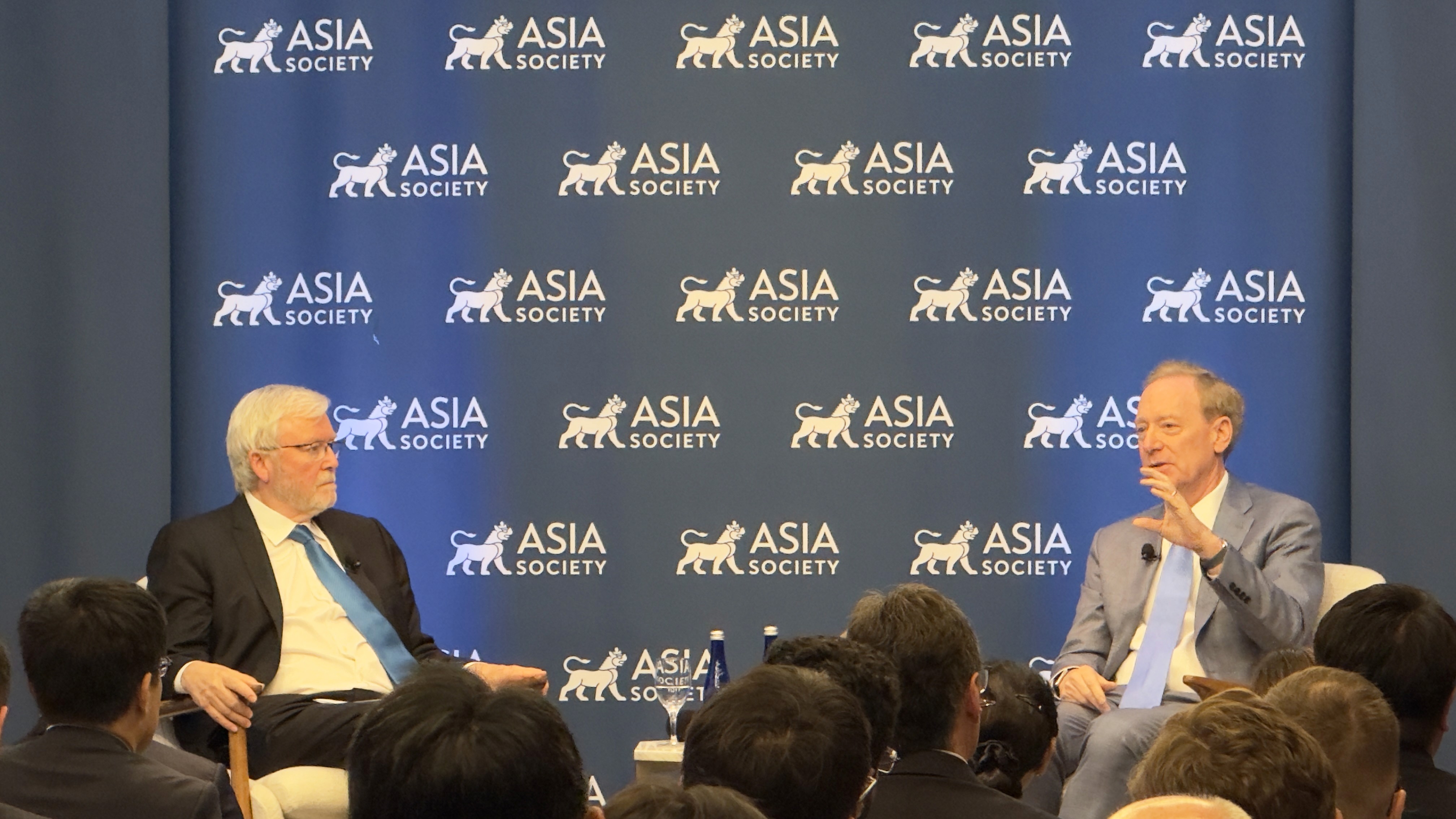
ⒸBrunchMagazine|
The conversation became more philosophical when Rudd challenged the way AI speaks.
His discomfort with ChatGPT using the word “I” was not merely about grammar. It was about the boundary between a person and a machine.
Language influences perception. When a system speaks in the first person, remembers past exchanges, and responds with apparent empathy, it can begin to feel less like a tool and more like a presence. That familiarity may be useful, but it can also obscure the distinction between simulated expression and human consciousness.
Smith’s response was measured and direct. AI systems should not be designed or understood as replacements for people. Their purpose should be to support human judgment, capability, and creativity.
This distinction will become increasingly important as AI enters education, healthcare, creative work, personal communication, and emotional life. The question will not be limited to whether a machine can perform a task. Society will also have to decide which relationships, responsibilities, and decisions must remain fundamentally human.
The Dignity of Work
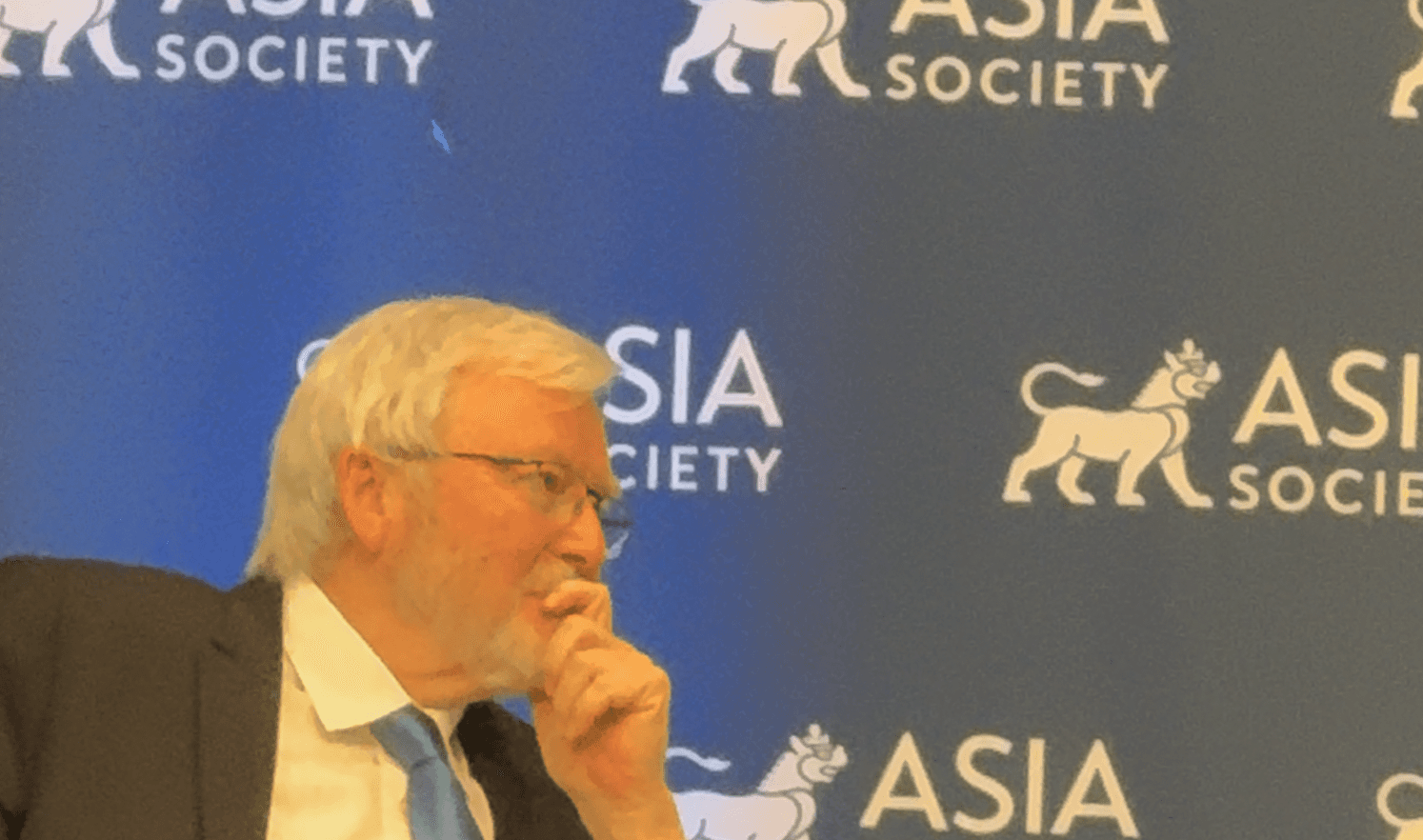
ⒸBrunchMagazine|
From identity, the discussion moved naturally to employment.
Rudd noted that technology leaders have often avoided directly answering one of the public’s most urgent questions: What happens to work when AI can perform an increasing number of human tasks?
Where will future jobs come from? How will workers move from disappearing roles into new ones? What responsibilities belong to technology companies, and what responsibilities belong to governments?
Smith again began with the future society should choose.
“I don’t think we want a future where AI does all the work and just sends us some money so that we can live our lives,” he said.
For Smith, employment is not merely a system for distributing income.
“There is dignity in work. There is purpose in work.”
Work gives people a way to contribute, participate, learn, and connect their individual lives to the needs of a larger community. Even after retirement, many people continue to seek meaningful forms of contribution through volunteering, family responsibilities, mentorship, or civic life.
This does not mean the world of work will remain unchanged. AI will alter tasks, professions, and the skills employers demand. But the goal should not be to remove people from productive life. It should be to use technology to strengthen what people are able to accomplish.
The distinction is crucial.
An AI future designed only around efficiency may reduce human participation. An AI future designed around dignity can expand human capability.
Productivity and Responsibility
Smith offered a personal example of how AI can improve productivity without replacing human judgment.
Each morning, an AI agent reviews the emails he has not yet addressed and produces a brief summary of the 12 most important messages. Smith reads the summary and decides how to respond.
The system organizes information. The human being remains responsible for attention, interpretation, and action.
This small example reflects a much larger principle. The most useful role for AI may not be to remove human beings from a process, but to reduce repetitive work so that human attention can be directed toward decisions that require experience, empathy, ethics, and accountability.
Yet the benefits of productivity will not distribute themselves automatically. Governments, companies, educators, and institutions will need to prepare people for changing professions and ensure that access to new tools does not deepen existing inequality.
The transition will require more than technical training. It will demand a renewed understanding of what society values in human work.
Regulation, Restraint, and Global Cooperation
The conversation concluded by widening its focus from individuals and workplaces to institutions and nations.
Rudd described Smith as a practical and grounded voice within the technology industry, someone capable of bringing discipline to an era of extraordinary innovation. He emphasized the need to establish the right balance between government regulation and corporate responsibility.
This balance cannot be achieved through regulation alone, nor can it be entrusted entirely to technology companies.
Governments must understand the systems they are regulating. Companies must accept responsibility for the consequences of what they build. Researchers, civil society, and the public must remain part of the conversation.
Smith’s public work at Microsoft covers the intersection of technology and society, including artificial intelligence, cybersecurity, privacy, human rights, and digital safety. Microsoft also identifies government action and greater responsibility from the technology sector as central to addressing the challenges created by emerging technologies.
The international dimension is equally important. AI development is already connected to cybersecurity, national security, trade, and competition between the United States and China. But the global nature of the technology also makes cooperation necessary.
No single company or country can independently resolve questions involving AI safety, employment, privacy, digital security, and human rights.
The Future Is Still a Human Decision
The most memorable part of the conversation was not a prediction.
It was the refusal to surrender the future to prediction.
AI may transform how knowledge is created, how institutions operate, and how people work. It may detect disease, recognize danger, translate languages, summarize information, and provide assistance on a scale once unimaginable.
But capability does not determine purpose.
People do.
The future will be shaped by the boundaries we maintain, the rights we protect, the responsibilities institutions accept, and the value we continue to place on human contribution.
When AI says “I,” it may sound increasingly human.
The more important question is whether humans will remain clear about what technology is for.
